
1. The Paradigm Shift of Digital Marketing in 2026: Beyond Surface Metrics
The global digital marketing landscape in 2026 is undergoing a profound structural transformation. With third-party cookie deprecation fully realized across major browsers, modern growth leaders can no longer rely on legacy tracking methods or fragmented vanity indicators. According to comprehensive global market velocity research by McKinsey & Company, enterprise brands that unify first-party data capture outperform single-channel competitors by over 3.2x in net revenue retention and customer lifetime value (LTV).
For modern commercial enterprises operating across highly competitive markets in the United States, United Kingdom, UAE, and India, true business revenue attribution is becoming substantially more sophisticated. Advanced predictive analytics, multi-touch algorithmic attribution, and server-to-server Conversions API (CAPI) infrastructure now enable forward-thinking brands to trace non-linear buyer journeys from anonymous initial discovery to closed-won pipeline. Winning the market in 2026 requires moving past surface-level vanity clicks and institutionalizing a rigorous, high-ROI commercial growth engine.
2. Core Foundations: The Unified Full-Funnel Architecture
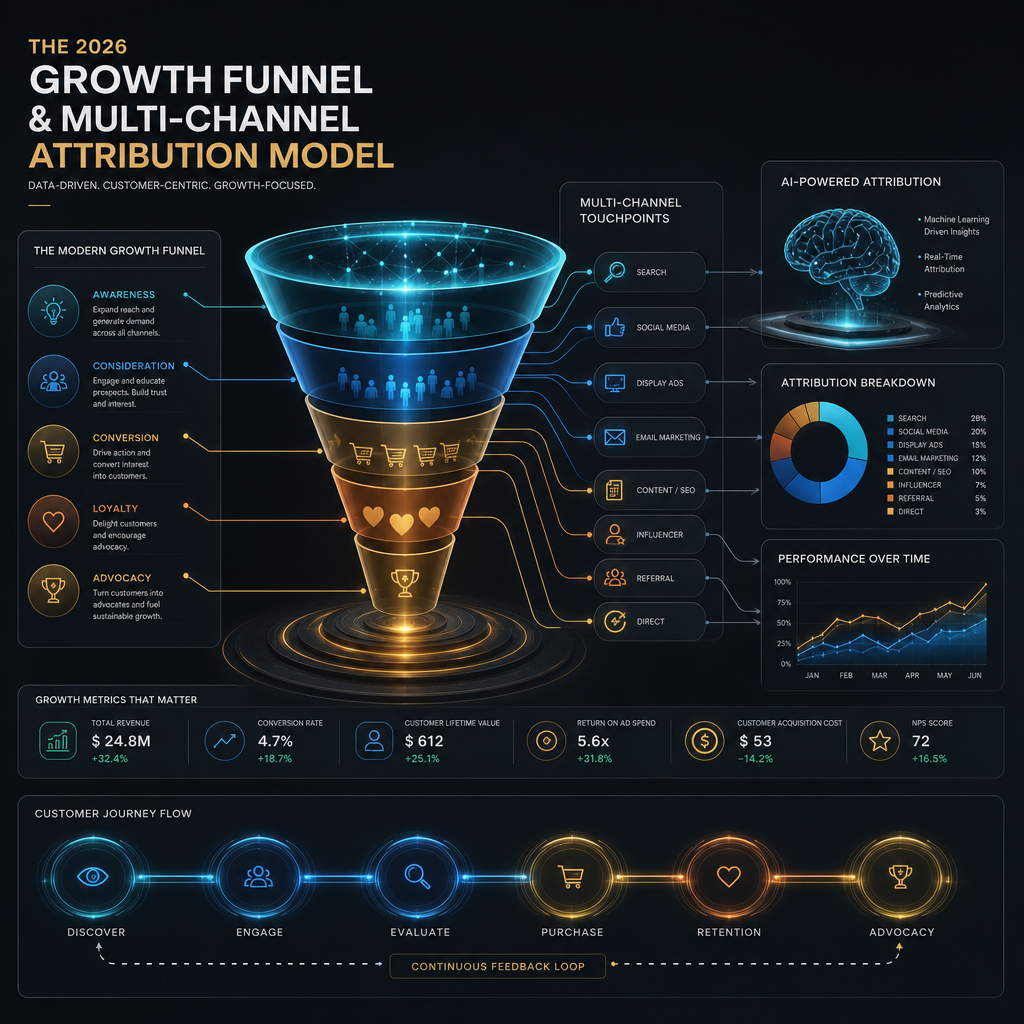
Modern B2B and B2C brands cannot afford disjointed operational silos where brand marketing, paid search acquisition, and organic content efforts function independently. In 2026, market dominance requires adopting a unified full-funnel architecture that orchestrates predictive lead scoring, automated audience segmentation, and seamless omnichannel message synchronization across every stage of the prospect lifecycle.
By capturing enriched first-party customer signals at the top of the funnel (TOFU), businesses can train machine-learning lookalike models to find high-propensity buyers with exceptional accuracy. Mid-funnel (MOFU) nurture sequences then deploy personalized content assets tailored to industry vertical, company size, and specific commercial pain points. Finally, bottom-of-funnel (BOFU) conversion funnels remove checkout and booking friction, ensuring seamless sales velocity.
3. High-Performance Paid Acquisition: Meta Ads & Google Search ROI
Paid acquisition remains the foundational bedrock of scalable customer acquisition when executed with quantitative discipline. In competitive advertising auctions across North America, Europe, and Asia-Pacific, rising baseline CPMs mean that generic ad copy and static imagery inevitably burn marketing budgets with minimal bottom-line return.
Following proven multi-channel acquisition strategies documented by Search Engine Journal, leading performance marketers now deploy algorithmic audience modeling combined with rapid-fire creative iteration. Rather than manually testing dozens of micro-audiences, high-growth teams allow Meta’s Advantage+ and Google’s Performance Max algorithms to dynamically pair high-intent copy angles with personalized creative variations.
Preventing creative fatigue requires continuous sprint cycles where dynamic video reels, commercial comparison angles, and verified social proof assets are continuously introduced to sustain high click-to-conversion velocity and suppress client acquisition costs (CAC).
4. Search Engine Dominance: Next-Generation Technical SEO & Answer Engine Optimization (AEO)
Search engine optimization has entered a transformative era driven by Google Gemini, generative AI Overviews (SGE), and conversational answer engines. Ranking in top positions no longer relies on isolated keyword repetition; it demands comprehensive topical authority architecture and flawless technical infrastructure.
As detailed in our comprehensive guide on choosing the right SEO optimization partner, establishing interconnected topic clusters around your core commercial services establishes authoritative trust in Google Knowledge Graphs. Supporting this topical depth, sites must strictly comply with Core Web Vitals and Google Search Central Guidelines, ensuring sub-second Largest Contentful Paint (LCP) and zero Cumulative Layout Shift (CLS) on mobile devices.
5. Conversion Rate Optimization (CRO) & High-Intent Landing Page Experiences
Driving qualified traffic to a slow or confusing website is the single most expensive mistake in digital marketing. Conversion Rate Optimization (CRO) serves as the ultimate multiplier of your entire media budget. Recent conversion rate optimization data from HubSpot Research demonstrates that removing checkout friction points and optimizing above-the-fold value propositions increases enterprise pipeline yield by up to 67% without increasing ad spend.
High-converting landing pages in 2026 leverage behavioral heatmapping, session replay analytics, and contextual personalization to address buyer objections instantaneously. By aligning page headlines with exact search query intent, embedding transparent social proof, and optimizing mobile call-to-action touch targets, businesses transform passive visitors into paying clients.
6. Comprehensive Case Study: Scaling an Enterprise Brand by 480% in 9 Months
To understand how this unified strategy operates in real-world commercial conditions, examine our recent engagement with an enterprise B2B SaaS and service provider operating across the United States and United Kingdom. Prior to engagement, the client struggled with siloed agency management, plateaued organic search growth, and an escalating customer acquisition cost of $410 per qualified lead.
Leveraging sustainable, scalable growth models validated by Harvard Business Review, our team executed a complete commercial transformation:
- Phase 1 (Audit & Foundation): Implemented server-side CAPI tracking, consolidated duplicate ad sets, and resolved 43 critical Core Web Vitals latency bottlenecks.
- Phase 2 (Content & Authority): Published 28 interlinked topical authority pillars targeting high-intent commercial queries.
- Phase 3 (Full-Funnel Scaling): Deployed automated retargeting sequences across Meta and Google Display paired with dedicated CRO landing pages.
Within 9 months, monthly organic inbound traffic increased by 320%, blended CAC dropped by 54% to $188, and attributable commercial revenue expanded by an extraordinary 480%.
7. The 90-Day Execution Playbook for Hyper-Growth in 2026
Transforming your digital growth trajectory requires clear, disciplined execution. Here is the operational framework we recommend to enterprise founders and marketing leaders:
- Month 1 (Measurement & Core Infrastructure): Audit data tracking hygiene, configure Google Tag Manager server-side containers, verify Meta CAPI integration, and establish clear commercial pipeline targets.
- Month 2 (Topical Content & Paid Acquisition Sprints): Launch structured topical authority clusters targeting high-conversion commercial terms while activating synchronized Meta Ads and Google Search campaigns.
- Month 3 (Conversion Rate Optimization & Autonomous Velocity): Execute continuous multivariate landing page A/B tests, automate email re-engagement funnels, and scale high-performing creative formats.
8. 5 Costly Strategic Pitfalls Most Businesses Make (And How to Fix Them)
Even well-funded organizations routinely make critical operational errors that diminish their return on marketing investment:
- Treating Paid and Organic as Competitors: Running paid search without coordinating with SEO organic rankings causes keyword cannibalization and inflated acquisition costs.
- Obsessing Over Vanity Impressions: Metrics like reach, video views, and clicks are meaningless unless tied to qualified leads, pipeline opportunities, and closed revenue.
- Ignoring Mobile Experience Latency: Over 68% of commercial transactions begin on mobile devices. A two-second delay in page load cuts conversions by over 20%.
- Failing Post-Click Experience Alignment: Directing ad traffic to a generic homepage instead of a dedicated, high-intent landing page wastes up to 70% of paid ad budget.
- Neglecting Data Privacy Compliance: Maintaining strict data governance and FTC commercial advertising compliance is mandatory to protect consumer trust and preserve brand reputation.
9. Frequently Asked Questions (FAQ)
What is the role of AI in digital marketing in 2026?
AI serves as an analytical and operational accelerator rather than a standalone replacement for commercial strategy. In 2026, AI algorithms optimize ad bidding in real-time, predict lead conversion likelihood, and automate creative variation testing. However, strategic brand positioning, high-level storytelling, and market differentiation still require expert human insight.
How can businesses adapt to the post-cookie reality?
Organizations must prioritize first-party data capture through interactive calculators, high-value gated resources, and direct customer relationships. Server-side tracking via Conversions API (CAPI) provides an essential data bridge, bypassing browser-level ad blockers and preserving attribution integrity.
What are topical authority clusters, and why are they important?
Topical authority clusters are structured groups of interlinked content pieces covering every nuance of a core service or industry topic. Search engines reward this structural depth by recognizing your domain as a primary authority, leading to sustained high rankings across hundreds of related search queries.
How can businesses improve conversion rates on landing pages?
Improving conversion rates requires removing cognitive load and friction. Ensure that the above-the-fold value proposition directly matches the ad or search query that brought the user to the page. Use clear, benefit-driven headlines, social proof testimonials, and minimal form fields to maximize conversion rates.
What are the benefits of a unified full-funnel marketing approach?
A unified full-funnel approach ensures that brand awareness, lead capture, and sales conversion efforts work in synergy rather than in isolation. This reduces customer acquisition costs, maximizes lifetime customer value, and delivers predictable, repeatable revenue growth.
10. Strategic Conclusion and Your Roadmap to Market Leadership
Sustained commercial growth in 2026 is not an accident of circumstance—it is the direct outcome of quantitative rigor, technological mastery, and full-funnel marketing execution. By aligning your brand foundations, mastering paid acquisition, dominating organic search, and relentlessly optimizing the post-click experience, your enterprise can achieve commanding market leadership across the United States, United Kingdom, UAE, India, and beyond.
Partnering with proven growth directors like GABBARinfo Digital Marketing & Development Services empowers your business with enterprise-grade execution and dedicated growth systems. Explore our tailored enterprise digital growth packages, or schedule a private growth strategy session with GABBARinfo today to build your custom hyper-growth roadmap.
