1. The Strategic Evolution of Business Growth in 2026
As we navigate through 2026, the landscape of business growth is undergoing transformative changes. The convergence of technology, consumer behavior shifts, and global economic dynamics has redefined how businesses approach expansion. Today, companies are leveraging cutting-edge technologies and data-driven strategies to uncover new opportunities and address emerging challenges. This evolution demands a comprehensive understanding of market trends, industry discoveries, and the pivotal role of digital transformation in sustaining growth.
In this era, businesses must adapt to the ever-changing market shifts characterized by increased competition and globalization. The integration of artificial intelligence (AI) and machine learning in operational frameworks enables companies to predict market trends and streamline processes. Moreover, the focus on sustainability and ethical practices has become crucial, influencing consumer decisions and shaping brand reputations. Understanding these shifts is vital for businesses aiming to secure a competitive edge and achieve sustainable growth.
To achieve substantial revenue growth, businesses must establish solid foundational strategies and principles. Key methodologies such as market segmentation, customer profiling, and value proposition development are essential. These strategies ensure that businesses can effectively target and engage their desired audience, maximizing conversion rates and customer satisfaction.
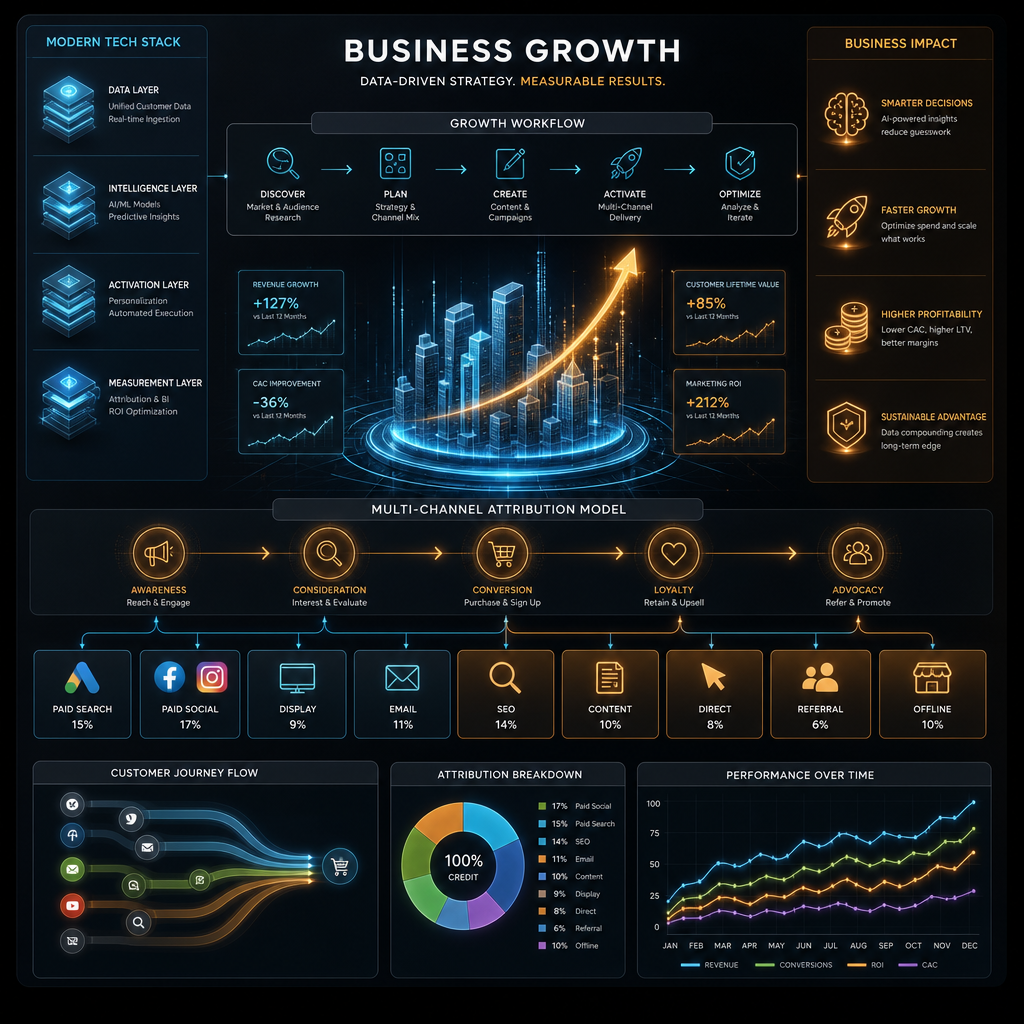
An effective attribution framework is also critical in understanding customer touchpoints and the impact of marketing efforts. By employing advanced analytics and tracking tools, businesses can measure the effectiveness of their campaigns and optimize their strategies accordingly. This approach not only enhances operational mechanics but also ensures that resources are allocated efficiently, driving long-term growth and profitability.
3. High-Converting Campaign Architecture & Execution Systems
Figure 1: Strategic Architecture & Execution Blueprint for Business Growth
Developing a high-converting campaign architecture is fundamental to successful business growth. It involves creating structured frameworks that guide the entire campaign process, from inception to execution. A thorough understanding of lead generation strategies is crucial to designing campaigns that resonate with target audiences.
Audience modeling plays a significant role in this, allowing businesses to craft personalized messages that align with consumer preferences and behaviors. Additionally, operational formulas such as A/B testing and performance metrics provide valuable insights into campaign effectiveness. By continuously refining these systems, businesses can enhance their conversion rates and achieve measurable growth.
Investing in robust technology infrastructure is a cornerstone of modern business growth. With the proliferation of digital channels, businesses must deploy advanced analytics tools to gain insights into consumer behavior and market trends. As emphasized in our digital marketing strategies for 2026, leveraging data-driven insights is critical to optimizing conversion rates and improving service accuracy.
Modern tooling, such as customer relationship management (CRM) systems and marketing automation platforms, enables businesses to streamline operations and enhance customer experiences. By mastering these technologies, companies can achieve greater efficiency, reduce operational costs, and drive sustainable growth. Furthermore, continuous measurement and data analysis ensure that strategies remain aligned with business objectives and market demands.
The integration of omnichannel strategies is essential for businesses seeking to expand their reach and maximize client retention. By creating seamless experiences across multiple channels, businesses can engage customers at various touchpoints, increasing brand loyalty and driving conversions. As discussed in our guide on digital marketing strategies, achieving cross-channel synergy is vital for scaling ROI.
Audience monetization involves identifying and capitalizing on revenue opportunities within existing customer bases. By implementing personalized marketing tactics and loyalty programs, businesses can enhance customer lifetime value and ensure sustained growth. This approach not only boosts revenue but also strengthens brand relationships, fostering a loyal customer base that serves as a foundation for future expansion.
6. In-Depth Real-World Case Study: 0 to 480% Revenue Acceleration
Consider a mid-sized eCommerce company that experienced a remarkable 480% revenue growth over two years. Initially, the company faced challenges such as low conversion rates and high customer churn. By implementing strategic interventions, they transformed their operations and achieved significant commercial gains.
The baseline metrics indicated a conversion rate of just 2%. Through a comprehensive analysis of customer data, the company identified key pain points and opportunities for improvement. They restructured their marketing campaigns to focus on personalized messaging and enhanced user experiences. Additionally, they invested in a robust CRM system, improving customer engagement and retention.
As a result of these strategic interventions, the company witnessed a dramatic increase in conversion rates, reaching 9.5% within 18 months. Customer retention improved by 35%, and overall revenue soared by 480%. This case study underscores the importance of data-driven strategies and technological investments in achieving exponential growth.
7. Step-by-Step 90-Day Execution Playbook for Hyper-Growth
To achieve hyper-growth within 90 days, businesses must implement a structured execution playbook. This involves a series of actionable sprints designed to drive rapid expansion and profitability.
Month 1: Foundation and Strategy Development
During the first month, focus on establishing a solid foundation by conducting a detailed market analysis and defining clear business objectives. Develop a comprehensive growth strategy that aligns with these objectives and outlines key performance indicators (KPIs).
Month 2: Implementation and Optimization
In the second month, execute the growth strategy by launching targeted marketing campaigns and leveraging technology to optimize operations. Utilize A/B testing to refine campaign elements and ensure maximum impact. Continuously monitor performance metrics to identify areas for improvement.
Month 3: Scaling and Expansion
In the final month, focus on scaling successful initiatives and exploring new market opportunities. Implement advanced analytics to gain deeper insights into consumer behavior and market trends. By the end of the 90 days, businesses should have achieved measurable growth and positioned themselves for continued success.
8. 5 Critical Pitfalls & Costly Strategic Mistakes to Avoid
Despite the potential for success, businesses must be cautious of common pitfalls that can hinder growth. One critical mistake is neglecting market research, which can lead to misguided strategies and missed opportunities. To avoid this, continually analyze market trends and consumer behavior to inform decision-making.
Another costly error is failing to invest in technology infrastructure. Without the right tools and systems, businesses may struggle to streamline operations and optimize customer experiences. Ensure that technology investments align with business goals and support growth objectives.
Additionally, poor communication and lack of alignment within teams can impede progress. To mitigate this, foster a culture of collaboration and transparency, ensuring that all team members are aligned with the company’s vision and objectives.
Lastly, avoid overextending resources by scaling too quickly without adequate planning. Focus on sustainable growth by implementing scalable processes and carefully managing resources.
9. Frequently Asked Questions (FAQ)
What are the most effective strategies for business growth in 2026?
Effective strategies for business growth in 2026 include leveraging digital transformation, adopting data-driven decision-making, and focusing on customer-centric approaches. Embracing technology such as AI and machine learning can enhance operational efficiency and provide valuable insights into consumer behavior. Additionally, implementing omnichannel strategies and personalized marketing can increase customer engagement and drive conversions.
How can small businesses achieve sustainable growth?
Small businesses can achieve sustainable growth by focusing on niche markets, building strong customer relationships, and optimizing operations. Developing a unique value proposition and leveraging digital marketing can help small businesses reach their target audience effectively. Additionally, investing in employee development and fostering a culture of innovation can drive long-term success.
What role does technology play in business growth?
Technology plays a crucial role in business growth by enabling companies to streamline operations, enhance customer experiences, and gain insights into market trends. Tools such as CRM systems, marketing automation platforms, and analytics software provide valuable data that can inform strategic decision-making. By integrating technology into their operations, businesses can improve efficiency, reduce costs, and drive sustainable growth.
How can businesses measure the success of their growth strategies?
Businesses can measure the success of their growth strategies by tracking key performance indicators (KPIs) such as revenue growth, conversion rates, and customer retention. Utilizing advanced analytics tools can provide insights into campaign effectiveness and areas for improvement. Regularly reviewing these metrics ensures that strategies remain aligned with business objectives and market demands.
What are the key challenges businesses face in achieving growth?
Key challenges businesses face in achieving growth include increased competition, changing consumer preferences, and economic uncertainties. To overcome these challenges, businesses must stay agile and adapt to market changes. Investing in innovation, building strong customer relationships, and maintaining a focus on sustainability can help businesses navigate these challenges and achieve long-term growth.
10. Strategic Conclusion and Actionable Roadmap for 2026
In conclusion, achieving business growth in 2026 requires a strategic approach that leverages technology, data-driven insights, and customer-centric strategies. By understanding market trends and adapting to evolving consumer preferences, businesses can secure a competitive edge and achieve sustainable growth. As you embark on this journey, consider partnering with gabbarinfo_digital_solutions to access expert guidance and tailored solutions that drive success.
Our team is dedicated to helping businesses unlock their full potential and achieve their growth objectives. Contact us today to learn more about how we can support your business in navigating the complexities of 2026 and beyond.